Monday, October 03, 2005

Award Winner


A TOUGH OLD COWBOY ONCE COUNSELED HIS GRANDSON THAT IF HE WANTED TO LIVE A LONG LIFE, THE SECRET WAS TO SPRINKLE A PINCH OF GUNPOWDER ON HIS OATMEAL EVERY MORNING. THE GRANDSON DID THIS RELIGIOUSLY AND LIVED TO THE AGE OF 110. HE LEFT 4 CHILDREN, 20 GRANDCHILDREN, 30 GREAT-GRANDCHILDREN, 10 GREAT-GREAT GRANDCHILDREN AND A FIFTY FOOT HOLE WHERE THE CREMATORIUM USED TO BE.

Independent AIM Member - Marilyn Wilson Price

Sunday, October 02, 2005

Texans FOR Marriage NOV 8

We NEED your help. Vote Nov 8 FOR the Marriage Amendment to the Texas Constitution
- Please help get the word out!
(There are a total of 9 proposed amendments - see sample ballot.)

Sample Ballot - http:////:www.texansformarriage.org/SampleBallot.pdf

Analyses of the 9 Constitutional Amendments http://www.tlc.state.tx.us/pubsconamend/pubsconamend.html

Best Website - http://www.texansformarriage.org

Register to Vote - http://www.sos.state.tx.us/elections/voter/reqvr.shtml

Free Voters' Guides - http://www.freemarket.org/portal/index.php?option=displaypage&Itemid=165&op=page&SubMenu=
To reserve your copy of the Voters' Guides for the 2005 Constitutional Amendments or request a bulk shipment for your church, please call 972-423-8889 x104 or e-mail: programs@freemarket.org

Justice at the Gate

Building strategic partnerships to mobilize Christians
to pray effectively and to vote righteously
PO Box 681148
San Antonio, Texas 78268
Alice Patterson, President
(210) 677-8214

http://www.justiceathegate.org
JusticeAtTheGate@aol.com


September 27, 2005


SPECIAL ELECTION NOVEMBER 8, 2005


In May both houses of the Texas Legislature passed HJR6 stating that "that marriage in this state consists only of the union of one man and one woman and prohibiting this state or a political subdivision of this state from creating or recognizing any legal status identical or similar to marriage." Although our state had passed a "Defense of Marriage Act" a couple of years ago, our legislators understood that it was necessary to make marriage between one man and one woman a part of our state constitution so that it would be beyond the reach of activist judges who have struck down similar statutes in different states across the nation. The next step is for registered voters in Texas to approve the amendment, now known as PROPOSITION 2, in the Special Election on November 8, so that it can become a part of our constitution.


HOW DOES A HOMOSEXUAL COUPLE GETTING MARRIED AFFECT ME?


That's a question many pastors are asking. Intercessors Network of Sweden (Intercessors.Network@Comhem.se) reports the following:


"CANADIANS OPPOSED TO HOMOSEXUALITY FACE HUMAN RIGHTS TRIBUNALS


With the passage of legislation legalizing same-sex marriage in Canada and the inclusion of sexual orientation in the “hate propaganda” sections of the Criminal Code of Canada, assurances were made by the federal government that those opposed to the legislation on religious grounds would not face recrimination. This assurance was questioned by many and this questioning appears to be justified with recent human rights complaints.


When same-sex marriage was legalized, marriage commissioners across the country raised questions about their obligations under the new legislation. The province of Saskatchewan has taken a particularly harsh stance, stating that all commissioners must either be willing to perform same-sex marriages or resign. Instead, Orville Nichols and two other commissioners filed a human rights complaint against the province. Nichols likewise faces a human rights complaint after he refused to marry a same-sex couple in May.


An Alberta pastor, Stephen Boissoin, also faces a complaint filed by an assistant professor of the University of Calgary and gay-rights advocate, Darren Lund. The complaint centers on Boissoin’s letter to the editor published in the Red Deer Advocate in June 2002. The initial complaint was dismissed by the Alberta Human Rights Commission, but it has been appealed. The date of the hearing has not been set but is expected shortly.


Bishop Fred Henry from Calgary also faced similar action for a pastoral letter sent to his Catholic constituency, protesting the same-sex marriage legislation. This complaint was dropped in late August when the complainant, Norm Greenfield, admitted that his complaints were intended primarily to attract media attention.


Pray that Christians in Canada will be free to voice their position on ethical issues without the threat of legal action.
Pray that the federal and provincial governments will pass and enforce legislation protecting religious rights.
Pray for these and others facing complaints for raising their voice on ethical issues."

If same-sex marriage is legalized in Texas it would remove the "teeth" from the battle that many pro-family leaders and parents are engaged in concerning public schools teaching that "alternate lifestyles" are acceptable.

Supporting Proposition 2 and agreeing with God's righteous standard as the law of the land doesn't mean that our churches and our hearts are closed to homosexuals who need God's grace and ministry. We can stand for righteous laws and have a heart of compassion and open doors to any person trapped in sin in our congregations.

What does God say about it?

After the Lord commends the Church at Thyatira for her works, charity, service, faith and patience, He says this in Revelation 2:20, "Nevertheless I have a few things against you, because you allow (tolerate, permit) that woman Jezebel…to teach and seduce My servants to commit sexual immorality…" We are not only judged for our compassion but for what we tolerate.

The church must weigh in on this election to insure that God's standard for marriage is the law of the land.


Will you do three things over the next five weeks?


1. Register Voters in your church through October 9?


Some tips about Voter Registration.

You must be a citizen, not just a legal resident to register to vote.


Individuals who will be 18 by November 8 can register to vote now.

Anyone who has moved, even in the same precinct must register to vote again.

In Texas a member of the immediate family can register members of their immediate households. So you can register your wife, husband and children.

It's not necessary to be deputized to register voters in your church. Just have your folks fill out the Voter Registration Cards, collect them in a box marked MAIL and DROP THEM IN THE MAILBOX. DO NOT DELIVER them to the Elections Office.

Don't be confused by the pocket on the new cards. It's not necessary to include a copy of your identification to register. You'll be asked to show ID the first time you vote in a federal election.

For your voter registration to be valid for the November 8 election, the Voter Registration Cards must be postmarked by October 11.


You may pick up Voter Registration Cards at your county elections office or call the Secretary of State's office at 1-800-252-8683 and they will mail them to you.

Visit http://www.sos.state.tx.us/elections/voter/reqvr.shtml to print a Voter Registration Card that requires postage to mail or to request a postage-free card be sent to you personally. You must call for bulk mailings.


Early Voting is October 24 – November 4.

2. Deliver Voter Guides for Distribution in Churches October 23-November 6


One of the most important things you can do for the election is to distribute Voter Guides. Although Proposition 2 is the only moral issue on the ballot, there are 9 Constitutional Amendments on the ballot.


Free Market Foundation will print and distribute 3 million voter guides before the election. The Voter Guides give the PROS and CONS of Proposition 2 as well as the other 8 constitutional amendments that will be on the ballot.


Estimate one voter guide per household for those who attend on Sunday morning and order the number of VOTER GUIDES you need at the bottom of the attached form. Let us know the number you need in ENGLISH and the number of Spanish voter guides you need. The Voter Guides will be mailed by the beginning of Early Voting October 24.


Consider being a distribution point for churches in your city or county. Order enough voter guides for your area and send teenagers to deliver them to the churches right up until Election Day.


3. Get the word out to other pastors in your denomination, city and county


Most Texas pastors support marriage between one man and one woman. They just don't know there's an election in November.


Please get the word out to other pastors to:

Register voters

Distribute VOTER GUIDES


VOTE


YOU ARE FREE SO SPEAK ABOUT THIS FROM THE PULPIT, RADIO AND TV

Preach about it from your pulpit.
Announce it on your radio and TV program.
Write about it in your bulletin and church newsletter.
Unlike elections where candidates and political parties are involved, this election is legal for pastors and churches to ENDORSE Proposition 2 and GET OUT THE VOTE for marriage.
The restrictions that apply to elections where candidates and political parties are involved DO NOT APPLY to this election. Speak out about it.

A vote FOR Proposition 2 is a vote for God's righteous standard of marriage between one man and one woman.


Will you commit NOW to do MORE than just educate your own congregation? Get the word out to your sphere of influence, your denominational leader and other pastors in your city and county.

Passion is on the side of the opposition. We must overcome passivity to see a God's righteous standard as the law in Texas.

The outcome of this election may very well depend on YOU!


WEBSITE WITH EXCELLENT INFORMATION ABOUT THE NOVEMBER 8 ELECTION


Several pro-family leaders and groups, including Kelly Shackelford of Free Market Foundation, have collaborated together to give you accurate information and resources relating to the November 8 Special Election. It is http://www.texansformarriage.org. Several things of interest are:

Pastor Freedoms
Pastor Helps
Recent Studies
Scripture References
Sample Ballot


Fitness By Marilyn
Independent AIM Member - Marilyn Wilson Price

Sunday, August 14, 2005

Toxic Chemicals

When the front page of the Wall Street Journal covers it, you know it's time to take it seriously. Many chemicals that are ubiquitous and previously assumed to be safe are now being shown to have insidious health effects. More reasons to detoxify and alkalize your body every day!

Neil Carman, Ph.D.


Levels of Risk

Common Industrial Chemicals


In Tiny Doses Raise Health Issue

Advanced Tests Often Detect

Subtle Biological Effects;
Are Standards Too Lax?

Getting in Way of Hormones


By PETER WALDMAN
Staff Reporter of THE WALL STREET JOURNAL
July 25, 2005; Page A1

First in a Series: TOXIC TRACES, New Questions about Old Chemicals

For years, scientists have struggled to explain rising rates of some cancers and childhood brain disorders. Something about modern living has driven a steady rise of certain maladies, from breast and prostate cancer to autism and learning disabilities.

One suspect now is drawing intense scrutiny: the prevalence in the environment of certain industrial chemicals at extremely low levels. A growing body of animal research suggests to some scientists that even minute traces of some chemicals, always assumed to be biologically insignificant, can affect such processes as gene activation and the brain development of newborns.

An especially striking finding: It appears that some substances may have effects at the very lowest exposures that are absent at higher levels.

Some scientists, many of them in industry, dismiss such concerns. But the new science of low-dose exposure is challenging centuries of accepted wisdom about toxic substances and rattling the foundation of environmental law.

Modern pollution restrictions aim to limit exposures to levels past studies have found safe. For example, it's known mercury can cause learning problems in children if it's above 58 parts per billion in the bloodstream. Dividing 58 by 10 to provide a margin of safety, U.S. regulators advise that children and young women not accumulate more than 5.8 parts per billion of mercury, by limiting consumption of certain fish such as tuna.

But what if it turned out some common substances have essentially no safe exposure levels at all? That was ultimately what the U.S. Environmental Protection Agency concluded about lead after studying its effects on children for decades. Indications some other chemicals may have no safe limits have led regulators in Europe and Japan to bar the use of certain compounds in toys and in objects used to serve food. In the U.S., federal scientists are devising new tests that could be used to screen thousands of common chemicals to make sure they're safe at extremely low exposures.

Using advanced lab techniques, scientists have found that with some chemicals, traces as minute as mere parts per trillion have biological effects. That's one-millionth of the smallest traces even measurable three decades ago, when many of today's environmental laws were written. With some of these chemicals, such trace levels exist in the blood and urine of the general population.

Some chemical traces appear to have greater effects in combination than singly, another challenge to traditional toxicology, which tests things individually.

The human body is complex, and effects seen in tests on small laboratory animals and in human cells don't necessarily mean health risks to people. "The question is what do we do about these low levels once we know they're there," says Steve Hentges of the American Plastics Council, a trade association.

For their part, companies and industry groups have attacked low-dose research as alarmist and are challenging the findings with scientific studies of their own. Some industry studies have contradicted the low-dose findings of university and government labs. One reason, says Rochelle Tyl, a toxicologist who does rodent studies on contract for industry groups, is that academics seek "to find out if a chemical has an intrinsic capacity to do harm," while industry scientists try to measure actual dangers to people.

The result is that low-dose research has sparked a number of heated scientific and regulatory controversies:

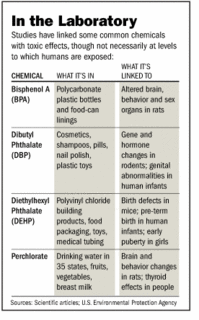
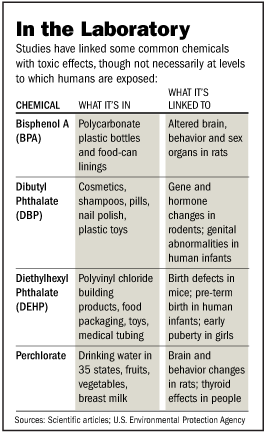
* Tiny doses of bisphenol A, which is used in polycarbonate plastic baby bottles and in resins that line food cans, have been found to alter brain structure, neurochemistry, behavior, reproduction and immune response in animals. Makers and users of the chemical maintain, citing a Harvard review of 19 studies, that the chemical is harmless to humans at such levels. (See illustration)

* Minute levels of phthalates, which are used in toys, building materials, drug capsules, cosmetics and perfumes, have been statistically linked to sperm damage in men and genital changes, asthma and allergies in children. The U.S. Centers for Disease Control and Prevention has detected comparable levels in Americans' urine. Manufacturers say there is no reliable evidence that phthalates cause any health problems.

* A chemical used in munitions, called perchlorate, is known to inhibit production of thyroid hormone, which children need for brain development. The chemical has been detected in drinking-water supplies in 35 states, as well as in fruits, vegetables and breast milk. The EPA has spent years mulling what is a safe level in drinking water. The Defense Department and weapons makers maintain it is harmless at much higher doses than those that Americans ingest.

* The weed killer atrazine has been linked to sexual malformations in frogs that were exposed to water containing just 1/30th as much atrazine as the EPA regards as safe in human drinking water. The herbicide's main manufacturer, Syngenta AG, says other studies prove atrazine is safe. The EPA favors more study.

With so much still unknown, regulators are proceeding on different tracks in different countries. Japan's government designates about 70 chemicals as potential "endocrine disruptors" -- substances that may, at tiny doses, interfere with hormonal signals that regulate human organ development, metabolism and other functions. Japan has just completed a $135 million research push on endocrine disruptors, including setting up a national research center. The Japanese government also has banned certain phthalates in food handlers' gloves and containers, after detecting them in food. One manufacturer, Fujitsu Ltd., has pledged to phase out its use of most suspected endocrine disruptors over coming years.

The European Union has banned some kinds of phthalates in cosmetics and toys, and it is considering a ban on nearly all phthalates in household goods and medical devices. The EU also is planning to require new safety tests for thousands of industrial chemicals, many of which already exist in people's bodies at trace levels. Industry, which would have to bear the cost of proving countless current products safe, is fighting the measures, calling them a massive unnecessary burden.

In the U.S., there are divisions within the government. The White House plays down the issue, saying the low-dose hypothesis is unproved. But many federal scientists and regulators at the EPA and Health and Human Services Department are forging ahead with new methods for assessing possible low-dose dangers. Legislatures in two states, California and New York, are considering bills that would ban use of certain phthalates in toys, child-care products and cosmetics, while a California bill would restrict bisphenol A.

Earliest Concerns

One of the early scientists to focus on possible low-dose risks was biologist Theo Colborn of the World Wildlife Fund. Studying the decline of certain birds, mammals and fish in the upper Midwest, Dr. Colborn spotted some patterns: Species that struggled to survive in the industrialized Great Lakes thrived in inland areas that were less polluted. And some offspring in more-polluted regions had gender abnormalities, such as feminized sex organs in males. She theorized that trace amounts of chemicals in the environment were disrupting hormones.

Dr. Colborn and colleagues popularized low-dose concerns in a series of conferences, articles and a best-selling 1996 book called "Our Stolen Future." That year the EPA asked an outside advisory panel to consider ways of screening industrial chemicals for hormonal effects, a process still incomplete.

In 2000, a separate EPA-organized panel, after reviewing 49 studies, said some hormonally active chemicals affect animals at doses as low as the "background levels" to which the general human population is subject. The panel said the health implications weren't clear but urged the EPA to revisit its regulatory procedures to make sure such chemicals are tested in animals at appropriately small doses.

The EPA hesitated. It responded in 2002 that "until there is an improved scientific understanding of the low-dose hypothesis, EPA believes that it would be premature to require routine testing of substances for low-dose effects."

The Bush administration's regulatory czar, John Graham -- administrator of the Office of Information and Regulatory Affairs at the White House Office of Management and Budget -- later publicly dismissed as unproven the idea that the hormonal system could be disrupted by multiple low-dose exposures to industrial chemicals. For the past two years, the administration has proposed funding cuts for EPA research on suspected endocrine disrupters, but Congress has kept the funding roughly level at about $10 million a year.

Since the review panel met in 2000, scientists have published more than 100 peer-reviewed articles reporting further low-dose effects in living animals and in human cells. These findings are generating some early insights in the thorny process of translating laboratory data into conclusions about human health.

Less Is More

One of the most provocative is that some hormonally active chemicals seem to have more effects at extremely low exposures than at higher ones. This challenges an axiom of toxicology stated by the Swiss chemist Paracelsus nearly 500 years ago: The dose makes the poison.

Toxicologists traditionally derive risk by exposing rodents to chemicals to find the lowest dose that leads to tumors, birth defects or other readily observable effects. Regulators then divide the highest "no-observable-effect" dose by an "uncertainty factor" -- anywhere from 10 to 1,000 -- to set a maximum human exposure they can be confident is safe.

But now researchers have found chemicals that have hormonal effects on lab animals and on human cells in much tinier amounts than their standard no-observable-effect levels. And with some of these chemicals, as the tiny doses given to animals are increased, the effects recede. Then, at much higher levels, broad systemic impacts appear, such as reduced body weight.

An example is bisphenol A, or BPA, the ingredient in polycarbonate baby bottles and food-can linings. It evidently is widespread in the environment. In the U.S., the CDC has found traces of it in 95% of urine samples tested. In Japan, researchers have detected BPA in fetal amniotic fluid and the umbilical cords of newborns.

Studying BPA in rats in 1988, the EPA concluded the lowest exposure with an "observed adverse effect" was 50 milligrams a day per kilogram of body weight (one kilogram = 2.2 pounds). Dividing 50 by an uncertainty factor of 1,000, the agency set a daily safe limit for humans of 0.05 milligrams of BPA per kilogram of body weight. Since then, however, academic scientists in several countries have done more than 90 studies that have found BPA effects on animals and human cell cultures from exposures well below this level.

The EPA used a relatively crude measure of the chemical's effects: changes in rodents' body weights. The new studies looked at subtler, hormone-related effects. Some studies found changes in rodents' reproductive organs and brains at doses as low as 0.002 milligram per kilogram of body weight per day. That is just one-25,000th the dose that the EPA said was the lowest exposure having an observable adverse effect.

Disrupting Hormones

Seeking to explain this pattern, scientists cite the endocrine system's exquisite sensitivity. Animals and humans secrete infinitesimal amounts of various hormones, such as estrogen, that trigger responses when they occupy special receptors on the cells of various organs. BPA is among numerous chemicals that can mimic estrogen by occupying cells' estrogen receptors. When they do this at critical phases of development, the chemicals can trigger unnatural biological responses, such as brain and reproductive abnormalities.


At higher doses, however, BPA and other endocrine disruptors -- instead of triggering the unnatural responses -- appear to overwhelm the receptors. That explains, scientists say, why some chemicals seem to have more potent hormonal effects at very low doses than at higher ones.

Mr. Hentges of the American Plastics Council says studies show BPA is harmless at the tiny levels to which humans are exposed. In 2001 the plastics council agreed to pay Harvard's Center for Risk Analysis, part of the Harvard School of Public Health, $600,000 to review BPA studies. The 10 panelists found "no consistent affirmative evidence of low-dose BPA effects" on the basis of 19 studies that were selected by April 2002 for review.

However, many more BPA studies kept coming out, and when the center published its report last fall, three of the 10 panelists declined to be listed as authors. "There are other papers published after the 'cut-off' date that the panel did not review that may have altered their conclusions," says one of the three, Paul Foster of the National Institute of Environmental Health Sciences. A fourth, Claude Hughes of Quintiles Transnational Corp., a pharmaceutical consulting firm, signed but made the same point in a journal commentary criticizing the report and calling for a new EPA risk assessment. The Harvard risk center's executive director, George Gray, acknowledges that a "torrent of new papers on BPA" may have made it impossible for the panel to review everything by its deadline.

The plastics council's Mr. Hentges says his group reviews all studies on BPA and believes none have changed the basic conclusion of the Harvard report. "We continue to believe that the weight of evidence indicates BPA poses no risk to human health," he says.

Chemicals in Combination

Environmental chemicals don't exist in isolation. People are exposed to many different ones in trace amounts. So scientists at the University of London checked a mixture. They tested the hormonal strength of a blend of 11 common chemicals that can mimic estrogen.

Alone, each was very weak. But when scientists mixed low doses of all 11 in a solution with natural estrogen -- thus simulating the chemical cocktail that's inside the human body today -- they found the hormonal strength of natural estrogen was doubled. Such an effect inside the body could disrupt hormonal action.

"In isolation, the contribution of individual [estrogen-like chemicals] at the concentrations found in wildlife and human tissues will always be small," wrote the scientists, led by Andreas Kortenkamp, who directs research on endocrine disruptors for the EU. But because such compounds are so widespread in the environment, the researchers concluded, the cumulative effect on the human endocrine system is "likely to be very large."

To test chemicals, toxicologists traditionally dose animals with a single substance and then dissect them. But this method can't spot the subtle effects associated with today's multiple exposures to low-dose chemicals, says John Bucher, of the National Institute of Environmental Health Sciences.

Now he and his boss, Christopher Portier, are revamping the federal government's National Toxicology Program, which sets standards for how chemicals are tested. Over about seven years, they hope to develop a series of lab tests that will ultimately screen some 100,000 industrial compounds, individually and in mixtures, for biochemical "markers" such as effects on specific genes.

The chemicals then will be ranked by mechanism of action and suspected toxicity, and assigned priorities for further study. "It's taken us 25 years and $2 billion to study 900 chemicals," Dr. Portier says. "If this works, we can study 15,000 in a year."

Write to Peter Waldman at peter.waldman@wsj.com


Fitness By Marilyn
Independent AIM Member - Marilyn Wilson Price

Thursday, July 28, 2005

Dust Off!

First IM going to tell you a little about me and my family. My name is Jeff. I am a Police Officer for a city which is known nationwide for its crime rate. We have a lot of gangs and drugs. At one point we were # 2 in the nation in homicides per capita. I also have a police K-9 named Thor. He was certified in drugs and general duty. He retired at 3 years old because he was shot in the line of duty. He lives with us now and I still train with him because he likes it. I always liked the fact that there was no way to bring drugs into my house. Thor wouldn't allow it. He would tell on you. The reason I say this is so you understand that I know about drugs. I have taught in schools about drugs. My wife asks all our kids at least once a week if they used any drugs. Makes them promise they wont.

I like building computers occasionally and started building a new one in February 2005. I also was working on some of my older computers. They were full of dust so on one of my trips to the computer store I bought a 3 pack of DUST OFF. Dust Off is a can of compressed air to blow dust off a computer. A few weeks later when I went to use them they were all used. I talked to my kids and my 2 sons both said they had used them on their computer and messing around with them. I yelled at them for wasting the 10 dollars I paid for them. On February 28 I went back to the computer store. They didn't have the 3 pack which I had bought on sale so I bought a single jumbo can of Dust Off. I went home and set it down beside my computer.

On March 1st I left for work at 10 PM. At 11 PM my wife went down and kissed Kyle goodnight. At 530 am the next morning Kathy went downstairs to wake Kyle up for school, before she left for work. He was sitting up in bed with his legs crossed and his head leaning over. She called to him a few times to get up. He didn't move. He would sometimes tease her like this and pretend he fell back asleep. He was never easy to get up. She went in and shook his arm. He fell over. He was pale white and had the straw from the Dust Off can coming out of his mouth. He had the new can of Dust Off in his hands. Kyle was dead.

I am a police officer and I had never heard of this. My wife is a nurse and she had never heard of this. We later found out from the coroner, after the autopsy, that only the propellant from the can of Dust off was in his system. No other drugs. Kyle had died between midnight and 1 Am.

I found out that using Dust Off is being done mostly by kids ages 9 through 15. They even have a name for it. It's called dusting. A take off from the Dust Off name. It gives them a slight high for about 10 seconds. It makes them dizzy. A boy who lives down the street from us showed Kyle how to do this about a month before. Kyle showed his best friend. Told him it was cool and it couldn't hurt you. Its just compressed air. It cant hurt you. His best friend said no.

Kyle's death

Kyle was wrong. It's not just compressed air. It also contains a propellant. I think its R2. Its a refrigerant like what is used in your refrigerator. It is a heavy gas. Heavier than air. When you inhale it, it fills your lungs and keeps the good air, with oxygen, out. That's why you feel dizzy, buzzed. It decreases the oxygen to your brain, to your heart. Kyle was right. It cant hurt you. IT KILLS YOU. The horrible part about this is there is no warning. There is no level that kills you. It's not cumulative or an overdose; it can just go randomly, terribly wrong. Roll the dice and if your number comes up you die. ITS NOT AN OVERDOSE. Its Russian roulette. You don't die later. Or not feel good and say I've had too much. You usually die as your breathing it in. If not you die within 2 seconds of finishing "the hit." That's why the straw was still in Kyle's mouth when he died. Why his eye's were still open.

The experts want to call this huffing. The kids don't believe its huffing. As adults we tend to lump many things together. But it doesn't fit here. And that's why its more accepted. There is no chemical reaction. no strong odor. It doesn't follow the huffing signals. Kyle complained a few days before he died of his tongue hurting. It probably did. The propellant causes frostbite. If I had only known.

Its easy to say hay, its my life and I'll do what I want. But it isn't. Others are always effected. This has forever changed our family's life. I have a hole in my heart and soul that can never be fixed. The pain is so immense I cant describe it. There's nowhere to run from it. I cry all the time and I don't ever cry. I do what I'm supposed to do but I don't really care. My kids are messed up. One wont talk about it. The other will only sleep in our room at night. And my wife, I cant even describe how bad she is taking this. I thought we were safe because of Thor. I thought we were safe because we knew about drugs and talked to our kids about them.

After Kyle died another story came out. A Probation Officer went to the school system next to ours to speak with a student. While there he found a student using Dust Off in the bathroom. This student told him about another student who also had some in his locker. This is a rather affluent school system. They will tell you they don't have a drug problem there. They don't even have a dare or plus program there. So rather than tell everyone about this "new" way of getting high they found, they hid it. The probation officer told the media after Kyle's death and they, the school, then admitted to it. I know that if they would have told the media and I had heard, it wouldn't have been in my house.

We need to get this out of our homes and school computer labs.

Using Dust Off isn't new and some "professionals" do know about. It just isn't talked about much, except by the kids. They know about it.

April 2nd was 1 month since Kyle died. April 5th would have been his 15th birthday. And every weekday I catch myself sitting on the living room couch at 2:30 in the afternoon and waiting to see him get off the bus. I know Kyle is in heaven but I cant help but wonder If I died and went to Hell.

Jeff


Fitness By Marilyn
Independent AIM Member - Marilyn Wilson Price

Saturday, July 23, 2005

I. C. E.


Not a bad idea!!
ICE -- In Case Of Emergency

A campaign encouraging people to enter an emergency contact number in their mobile phone's memory under the heading ICE (In Case of Emergency), has rapidly spread throughout the world as a particular consequence of last week's terrorist attacks in London.

Originally established as a nation-wide campaign in the UK, ICE allows paramedics or police to be able to contact a designated relative / next-of-kin in an emergency situation.

The idea is the brainchild of a paramedic for 13 years, said: "I was reflecting on some of the calls I've attended at the roadside where I had to look through the mobile phone contacts struggling for information on a shocked or injured person. Almost everyone carries a mobile phone now, and with ICE we'd know immediately who to contact and what number to ring. The person may even know of their medical history."

By adopting the ICE advice, your mobile will help the rescue services quickly contact a friend or relative - which could be vital in a life or death situation. It only takes a few seconds to do, and it could easily help save your life. Why not put ICE in your phone now? Simply select a new contact in your phone book, enter the word 'ICE' and the number of the person you wish to be contacted.

For more than one contact name ICE1, ICE2, ICE3 etc.

Fitness By Marilyn
Independent AIM Member - Marilyn Wilson Price

Sunday, July 17, 2005

Why Bother With Exercise?


"When we exercise routinely, our bodies work more efficiently and we use less energy to get better results. When we are in shape, we better use our energy when fighting disease or stress, or in the healing process. This can result in faster recovery, less stress, and a more powerful immune system.*"

Additionally, regular exercise':

1. Reduces the risk of dying prematurely and from heart disease, and of developing diabetes, high blood pressure, and colon cancer.

2. Helps reduce blood pressure in people who already have high blood pressure.

3. Reduces feelings of depression and anxiety; promotes psychological well-being.

4. Helps control weight.

5. Helps build and maintain healthy muscles, bones, and joints.

6. Helps older adults become stronger and better able to move without falling.


"People who are usually inactive can improve their health and well-being by becoming even moderately active on a regular basis, and physical activity need not be strenuous to achieve health benefits. For those interested in preventing bone loss and osteoporosis, experts recommend exercising at least three times per week.*" "Muscle strengthening and walking improve support and stability to reduce falls and fractures. For individuals of all ages, exercise should be the keystone of osteoporosis prevention and treatment.^"

"Exercising releases hormones, neurotransmitters (which help the brain communicate within itself), and other substances that help the body relax. It appears that exercise increases the levels of neurotrophins, proteins that stimulate the growth of new nerve cells in the part of the brain that deals with learning and memory.*" "There is growing evidence that regular physical activity helps to ward off mental declines as people age. A five-year Canadian study suggested that exercise may cut the risk of Alzheimer's disease and less devastating mental losses by as much as 40 per cent, particularly in women. Further, the report stated that those who exercised vigorously at least three times per week and were considered highly active, had the lowest risk of Alzheimer's, but even those receiving light or moderate exercise significantly cut their risks for Alzheimer's and mental decline.~"


Start Or Expand An Exercise Program Tips*:

1. Find activities that you enjoy!

2. Make the exercise convenient!

3. Vary your activities and how you do them!

4. Keep track of your progress!

5. Lighten Up!

6. Don't Give Up!

7. Make exercise a part of your day!


Other things which help are group sports, exercise classes, workouts at a health club, or exercising on equipment and using videos at home. Many people benefit from having a partner to exercise with. It is very encouraging to me that the medical profession is getting more knowledgeable about preventative medicine which is sometimes called integrated medicine. This has been so long in coming about. Also our insurance companies are covering preventative medicine and sponsoring exercise programs in our communities.


* AIM Partners, July-August, The AIM Companies
' Office Of The Surgeon General: "Physical Activity And Health Report"
^ The Physician And Sportsmedicine (vol. 26, 1998)
~ Archives Of Neurology (vol. 53, 2001)


Fitness By Marilyn
P. O. Box 834
Rockport, TX 78381
fitnessbymarilyn@gmail.com
http://www.fitnessbymarilyn.com
Independent AIM Member - Marilyn Wilson Price
The AIM Opportunity!


What The AIM Opportunity Brings To You!


* Minimum investment
* Low monthly expenses
* Wholesale prices on all products
* No monthly minimum purchase
* Permanent titles
* Compression at all levels
* Low qualification requirements
* First-of-month promotions
* Free annual renewal with minimum purchase
* Generous Leadership Bonus Program
* Exciting travel possibilities
* 100% satisfaction guarantee
* Tremendous income potential
* Commission paid on all Personal Volume—whether you qualify for commissions on others'

* purchases or not


Independent AIM Member - Marilyn Wilson Price